


Attack From Mars
Attack from Mars is a 1995 pinball game designed by Brian Eddy, and released by Midway (under the Bally label).
In this game, the player must fend off an alien invasion from the planet Mars by defending the world's major cities, destroying the invasion fleet, and conquering Mars itself.
Notable features on the playfield include four mechanized Martian figures and a strobe light (for Strobe Multiball).

Demolition Man
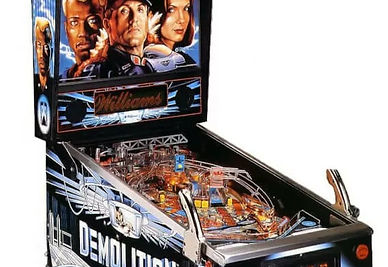
Demolition Man is a Williams pinball machine released in February 1994 and designed by game designer Dennis Nordman. The game is based on the motion picture of the same name. It is part of WMS' SuperPin line of widebody games.
Gameplay is centered around 4 multiballs, named Fortress Multiball, Museum Multiball, Wasteland Multiball, and Cryoprison Multiball. Completing all multiballs lights the Demolition Jackpot (the total of all jackpots scored in all mutiballs).
The main playfield toy is the Cryo Claw, a mechanical device that captures the ball from a right ramp shot (via a magnet) and is then user-controlled to drop the ball onto one of 5 possible awards: Start AcMag, Lock Freeze, Prison Break, Super Jets and Capture Simon. Completing the 5 awards lights "Demolition Time" a wizard mode starting at 3 balls and with a maximum of 5 balls multiball.
Demolition Man runs on Williams' WPC system with DCS sound. Custom speech was recorded by actors Sylvester Stallone and Wesley Snipes under direction of the game's sound designer Jon Hey.
Whirlwind
Whirlwind is a pinball machine produced by Williams in 1990 and was one of the last Williams System 11b games. It was designed by Pat Lawlor,[1] who created a previous natural disaster-themed pinball for Williams, Earthshaker!.
Whirlwind is distinguished by three playfield rotating discs, and a fan topper that blows wind on the player at certain times in the game. The objective in Whirlwind is to move the storm using the compass targets to light ball locks for multiball. In multiball, a progressive jackpot can be scored by making left ramp shots from the upper right flipper. Alternatively, one can work towards the "Wizard Mode" by lighting and collecting all of the seven "Super Cellar Door" values. Also, once player has earned five extra balls in a game, each one earned thereafter awards a score bonus.

Another Game
FunHouse is a pinball machine designed by Pat Lawlor and released in November 1990 by Williams Electronics.[1] Starring a talking ventriloquist dummy named Rudy, the game is themed after the concept of an amusement park funhouse. FunHouse is one of the last Williams games to use an alphanumeric display; the company switched to dot matrix the following year.
FunHouse's primary feature is the talking head of a ventriloquist dummy, named Rudy, located in the top right corner of the playfield. Rudy responds to events in the game, including informing the player of special bonuses, taunting and heckling the player, and appearing to follow the ball with its eyes when certain targets are hit. Rudy is voiced by Ed Boon, and the technology behind Rudy's facial movements was dubbed "Pin-Mation" by Williams.

Star Trek Next Gen
Star Trek: The Next Generation pinball machine is a widebody game, designed by Steve Ritchie and released in November 1993 by Williams Electronics. It was part of WMS’ SuperPin series (see also The Twilight Zone and Indiana Jones: The Pinball Adventure), and was based on the TV series. It is the only pinball machine that features three separate highscore-lists. Apart from the regular highscore-list and the buy-in-list, it also features a reminiscence to The Machine: Bride of Pin*Bot billionaires club. It is also the third pinball game overall based on the Star Trek franchise, following the 1979 pinball game by Bally, and the 1991 game by Data East (both based on the original series).
When a new ball is launched into the plunger, the player is given one of five launch awards, which is selected when the ball is fired. Unless otherwise noted, the ball is launched through the spiral ramp and into the lock hole (above the pop bumpers). Another ball is popped from the left scoop and onto the left inlanes.

Mousin' Around
Mousin’ Around Pinball Machine was manufactured by Bally in 1989. Mousin’ Around Pinball Machine is a tantalizing combination of super-charged playfield features, extra eye-catching primary color graphics, a whimsical musical score and superb electronics! It’s pinball loaded with charm and irresistible universal appeal!
“So You Wanna Mouse Around?”
Individual Scoring Memory: It’s every mouse for himself as players build their OWN jackpots and lock their own balls for amazing Mouse Trap Multi-Ball!
Bait Players with an irresistible test of skill and one tantalizing challenge after another! Only a few are quick enough to steal the cheese and escape unharmed to the refuge of the Mouse Hole!
Zip and Swoosh Ramps! Running through these nooks and crannies spells C-H-E-E-S-E and opens the gate for a clean sweep to the safety of the Mouse Hole. Every perilous trip home builds the Jackpot and earns the tasty Cheezy Bonus and an Extra Ball or Special!

Whirlwind
Whirlwind is a pinball machine produced by Williams in 1990 and was one of the last Williams System 11b games. It was designed by Pat Lawlor,[1] who created a previous natural disaster-themed pinball for Williams, Earthshaker!.
Whirlwind is distinguished by three playfield rotating discs, and a fan topper that blows wind on the player at certain times in the game. The objective in Whirlwind is to move the storm using the compass targets to light ball locks for multiball. In multiball, a progressive jackpot can be scored by making left ramp shots from the upper right flipper. Alternatively, one can work towards the "Wizard Mode" by lighting and collecting all of the seven "Super Cellar Door" values. Also, once player has earned five extra balls in a game, each one earned thereafter awards a score bonus.
Another Game
FunHouse is a pinball machine designed by Pat Lawlor and released in November 1990 by Williams Electronics.[1] Starring a talking ventriloquist dummy named Rudy, the game is themed after the concept of an amusement park funhouse. FunHouse is one of the last Williams games to use an alphanumeric display; the company switched to dot matrix the following year.
FunHouse's primary feature is the talking head of a ventriloquist dummy, named Rudy, located in the top right corner of the playfield. Rudy responds to events in the game, including informing the player of special bonuses, taunting and heckling the player, and appearing to follow the ball with its eyes when certain targets are hit. Rudy is voiced by Ed Boon, and the technology behind Rudy's facial movements was dubbed "Pin-Mation" by Williams.